
Nine times out of ten, this happens because the "bullseye" a beginner imagines doesn't match how NASP actually scores its target face. NASP uses a specific 5-zone, 10-ring system, and every coach, parent, and student needs a clear grasp of it to run fair practices and tournaments.
This guide breaks down the ring colors, point values, official target sizing, and the scoring rules unique to NASP, so nobody's left second-guessing an arrow again.
Key Takeaways
- Maximum score is 300 for 30 arrows on a 5-color, 10-ring face
- Gold 10-ring is smaller than most people assume—precision is rewarded
- Line cutters (arrows touching a ring boundary) always score the higher value
- Olympic/Metric and 3D formats use different rules—keep scoring systems separate by event
NASP Scoring Rings Explained
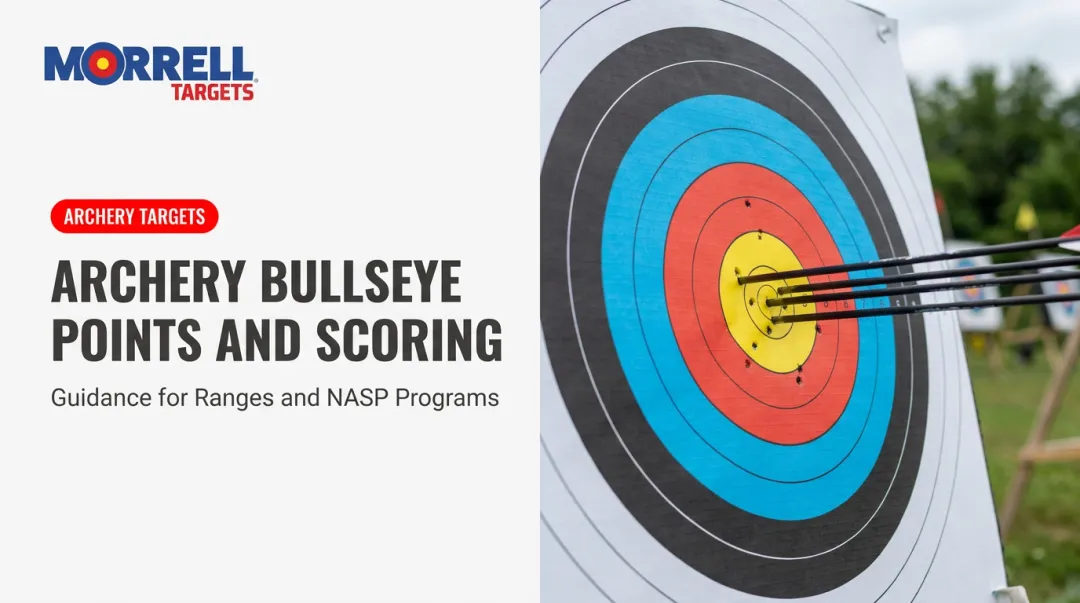
NASP's target face uses five colors, moving outward from center: gold (or yellow), red, blue, black, and white. Each color band contains two numbered scoring rings, for 10 total point values.
Here's the official breakdown:
| Zone | Rings | Points |
|---|---|---|
| Gold/Yellow | 10, 9 | 10 or 9 |
| Red | 8, 7 | 8 or 7 |
| Blue | 6, 5 | 6 or 5 |
| Black | 4, 3 | 4 or 3 |
| White | 2, 1 | 2 or 1 |

That's why a student's arrow in what looks like "the bullseye" can still score an 8: the red ring is technically part of the bullseye colors, but it isn't the 10-ring.
The X Ring Isn't Worth Extra
There's a small dot in the center of the 10-ring called the X. A common misconception is that hitting the X earns 11 points. It doesn't. The X ring counts as a 10, per NASP's national rulebook. It exists purely as a tiebreaker used to rank archers who finish with the same total score.
How Big Is the 10-Ring?
NASP's official rulebook specifies an 80 cm face (about 31.5 inches) for its Bullseye target. That is the confirmed measurement.
NASP has not published a separate 10-ring diameter in the rulebook, so coaches should avoid repeating unofficial numbers online. Practically, the 10-ring is noticeably smaller than the full gold zone, which is why "hitting the yellow" does not guarantee a perfect score.
The Line-Cutter Rule
If an arrow shaft touches a ring boundary line, it scores the higher value, even if most of the shaft sits in the lower ring. The key detail coaches need to teach: it's the shaft that must touch the line, not just the hole the arrow made. A hole that grazes a line without shaft contact stays at the lower score.

Comparing NASP Rings to Other Archery Formats
Schools running multi-format practices need to keep formats separate:
- NASP Bullseye uses five colors and 10 numeric rings (10 through 1), with X counting as 10 for tiebreaks only
- World Archery (Olympic/Metric) shares the yellow 10/9 and red 8/7 color zones, but follows different tournament rules and equipment standards
- NASP 3D/animal targets allow only five scores per arrow (0, 7, 8, 9, or 10) based on hit location on the animal silhouette
Mixing formats in a tournament—or in the practice leading up to one—creates scoring confusion fast. Keep rule sets distinct and clearly labeled for students.
How NASP Scoring Works Step-by-Step
NASP rounds follow a strict, repeatable structure:
- Practice end at 10 meters — five arrows, no score recorded
- Three scored ends at 10 meters — five arrows each (15 scored arrows total)
- Practice end at 15 meters — five arrows, no score recorded
- Three scored ends at 15 meters — five arrows each (another 15 scored arrows)
That adds up to 30 scored arrows, each worth up to 10 points, for a maximum possible score of 300.

Verification, Totals, and Scorecard Rules
Archers never score their own arrows. Instead:
- One partner calls out and bubbles the other's arrow values
- The checking partner examines the five-arrow end and confirms every value is bubbled
- Roles reverse for the next end
- Disagreements go to a range official for a final call
- Both archers sign once totals are confirmed
Add each end total into a running score across all six scored ends. Coaches should have archers track their 10s and Xs separately, since these break ties when two archers finish with the same overall score.
Miscounted arrows are one of the most common sources of disputes at school tournaments. Enforce these scorecard rules:
- Two values bubbled on one line: erase the higher value
- A blank line with no bubble scores zero, except in a documented duplicate-and-blank case
- Only range officials can erase marks, and each erasure must be documented
Perfect Scores and What They Really Mean in NASP
A perfect score is 300 points: all 30 scored arrows landing in the 10-ring. It's exceptionally rare, even among advanced NASP archers.
For context, NASP's own history notes that a perfect 300 was essentially unheard of during the program's first decade. The previous high score sat at 298 until 2012, when an archer finally broke through with the first official 300.
The NASP 300 Club
NASP maintains an official 300 Club roster recognizing archers who hit this mark. To qualify, the round must be shot in a sanctioned tournament with strict validation requirements:
- Multiple schools involved
- Minimum of 75 archers
- Random target assignments
- Signed confirmation from range officials and coaches

For coaches setting expectations with students, the takeaway is simple: treat 300 as a milestone, not a benchmark. Most competitive NASP archers will never shoot one, and that's normal. Progress should be measured in smaller, steady gains: tighter groupings, fewer 7s and 8s, and more consistent 9s and 10s.
Choosing the Right Targets for Consistent NASP Scoring
Faded or distorted scoring rings make it nearly impossible for young archers to judge a line cutter correctly. If the boundary between the 9-ring and 10-ring has blurred from thousands of practice shots, even a careful partner check won't produce a fair score. This is where target construction actually matters for scoring accuracy, not just durability. Morrell® Targets builds its NASP-related targets with a Multi-Layered Density Design (MLDD) and an Internal Frame System (IFS) that keep faces stable shot after shot. Rings stay legible after heavy repeated use, so coaches aren't second-guessing whether a call was accurate or the face simply wore out. For schools running high-volume programs, Morrell offers:
- NASP-specific target faces, including official 80 cm scoring paper
- NASP-approved youth bag targets, such as the Youth Deluxe GX, built for field points and bows up to 50 pounds
- Replacement covers, including NASP Youth and NASP Eternity, to refresh a worn face without replacing the whole target Replace worn scoring faces promptly—every student on the line deserves a fair call.

Common Scoring Mistakes NASP Coaches Should Watch For
A few recurring errors show up at nearly every school tournament:
- Assuming arrows must be fully inside a ring. The line-cutter rule awards the higher value when the shaft touches the boundary. Drill this early so students stop under-reporting scores.
- Skipping partner verification. Solo scoring or skipping the check-and-sign step lets errors slip through until they can't be fixed.
- Mixing NASP rules with 3D or Olympic scoring. Training across formats without separating rule sets confuses what a "10" means on each target.
Building good scoring habits early avoids disputes later, especially at larger tournaments where a range official's time is limited.
Frequently Asked Questions
How does NASP scoring work?
Archers shoot one practice end followed by three scored ends of five arrows at 10 meters, then repeat at 15 meters. That totals 30 scored arrows, for a maximum score of 300.
What is a perfect score in NASP archery?
A perfect score is 300 points: all 30 arrows landing in the 10-ring. It's rare enough that NASP maintains an official 300 Club to recognize archers who achieve it.
How many rings are on a NASP 5-zone archery target?
NASP's target face has five colors (gold, red, blue, black, white), each containing two scoring rings, for 10 total point values ranging from 1 to 10.
How big is the 10-ring on a NASP archery target?
NASP's official rulebook specifies an 80 cm target face. A separate official measurement for just the 10-ring isn't published in the national rulebook.
What happens if an arrow lands on a scoring line in NASP?
The line-cutter rule applies: if the arrow shaft touches a ring boundary, it scores the higher value. This only applies to the shaft, not just the hole it leaves.