The moment safety, legal compliance, and neighbor proximity enter the picture, though, the project gets technical fast. This isn't a "guess and go" setup — distance, backstop strength, and shot angle all need to be calculated correctly.
Get it wrong, and the consequences are real. Stray arrows can damage property or injure someone. HOA violations can trigger fines or complaints. Cheap targets can wear through in weeks under daily use.
This guide covers the full process: confirming legality, calculating your safety buffer, choosing equipment rated for your bow, and building a range designed to last.
Key Takeaways
- Confirm local laws and HOA rules before building — most setups skip this step
- Calculate your safety buffer zone using shooting distance, not target placement
- Match your target and backstop to your bow's draw weight and arrow speed
- Test-fire at reduced pace before treating the range as fully operational
- Inspect the range often, since weather and wear cause most long-term failures
Prerequisites and Safety Considerations
Before you level a single square foot of ground, confirm that archery is actually allowed on your property. Call your local code enforcement office, police department, or county clerk and ask directly:
- Is target archery permitted on residential property?
- Are there restrictions on shooting across roads, sidewalks, or public rights-of-way?
- Is there a minimum distance required from occupied dwellings?
Rules vary enormously by city. Ankeny, Iowa's municipal code, for instance, requires a target facing an exterior property line to have at least 150 feet of clearance behind it.
The code also sets lateral safety zones that scale with shooting distance: 24 feet at ranges up to 16 yards, growing to 1.5 times the target distance beyond 30 yards. That specific code requires direct adult supervision for archers under 16, too. Your city's rules will look different, but the pattern of layout, containment, and visibility conditions is common.
HOA and deed restrictions layer on top of city law. Even if your municipality allows backyard archery, your HOA's bylaws might not. Check your CC&Rs, and tell your neighbors about the range even if you're not required to. A quick conversation prevents a startled call to the police later.
Site readiness matters just as much as legality. You need a flat, level area free of trees, power lines, and structures, with enough depth for your shooting distance. Beginners generally need less room than experienced archers shooting longer yardages.
Finally, run a compatibility check: a backstop rated for a 30-pound youth bow will not contain a 70-pound compound bow. Match equipment strength to what you're actually shooting.
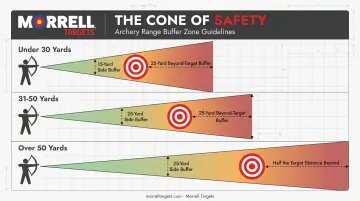
Understanding the Safety Buffer Zone ("Cone of Safety")
Your buffer zone is the empty space beyond and beside your target that catches deflected or off-target arrows. It's separate from your backstop: a backstop stops arrows on the intended path, while the buffer zone protects the area around it.
The Archery Trade Association's Community Archery Park Guide lays out planning benchmarks that scale with distance:
| Longest Shooting Distance | Side Buffer | Buffer Beyond Target |
|---|---|---|
| Under 30 yards | 15 yards | 25 yards |
| 31–50 yards | 25 yards | 25 yards |
| Over 50 yards | 25 yards | Half the longest target distance |
These are association design benchmarks, not universal legal minimums, but they're a solid starting point. The takeaway: the farther you shoot, the more space you need on every side, not just behind the target.
Non-Negotiables Before You Shoot
Do not take a single shot if any of these apply:
- No confirmed backstop is in place
- Your sightline crosses a road, sidewalk, or neighboring yard
- There isn't enough clearance behind the target
- Wind or storm conditions could deflect the arrow's path
Essential Equipment for a Safe Backyard Range
A safe range needs three things working together: a target, a backstop, and clear boundary markers. Skip any one, and you've created risk.
Target options fall into three categories:
- Bag targets: good for field points, easy arrow removal, budget-friendly
- Foam targets: quieter impact, more durable, handle a wider range of arrow tips
- 3D targets: realistic silhouettes for hunters practicing shot placement
Whatever you choose, match it to your bow's FPS rating. An entry-level target like the Yellow Jacket® Supreme 3, rated to 375 FPS, works fine for lighter compound setups. A high-poundage bow pushing 400+ FPS needs something like the YJ-450 Plus, rated for 450 FPS and beyond.
Morrell's High Roller Foam line covers a wider range at once, handling everything from 30-pound youth bows to crossbows up to 450 FPS. For shooters running high-speed crossbows beyond that, the Yellow Jacket Kinetic X is rated for bolt speeds up to 500 FPS. That flexibility matters if multiple family members with different bow weights share one range.
Backstops carry their own tradeoffs:
| Backstop | Pros | Cons |
|---|---|---|
| Hay bales | Inexpensive | Needs regular gap maintenance |
| Earth berms | Permanent, effective | Labor-intensive to build |
| Rubber/foam mats | Reusable, quieter | Limited thickness options |
| Arrow-stopping netting | Lightweight | Only safe under 30 lb draw weight |
| Commercial target stands | Built-in containment | Higher upfront cost |
Beyond the target and backstop, a few extra items round out a functional range:
- Rangefinder or tape measure for accurate distance marking
- Ground or hip quiver
- Bow rack
- Arm guard or release aid
- Rope or stakes to mark shooting and waiting lines
A backstop and target are non-negotiable. Lighting, storage sheds, and covered shelters are optional upgrades, nice to have but not required to shoot safely.
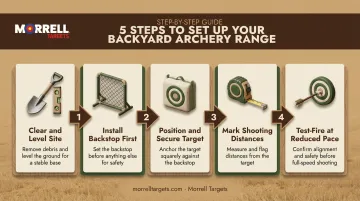
How to Set Up Your Backyard Archery Range: Step-by-Step
Setup follows a specific order. Skip a step, such as installing the target before the backstop, and you'll end up redoing work.
Clear and level the shooting site. Remove debris, rocks, and anything that could cause an unstable stance. Confirm the sightline is free of hazards in every direction.
Install the backstop first. It needs to extend at least 2 feet beyond the target's width and height on all sides. This catches off-center shots that would otherwise sail past the target entirely.
Position and secure the target in front of the backstop. Check that it stands stable and won't shift or tip after repeated impacts. A wobbling target throws off your aim and creates inconsistent arrow paths. Heavy-duty foam or bag targets with reinforced frames stay planted without extra anchoring.
Measure and mark shooting distances permanently. Backyard setups typically run 10 to 20 yards. Use stakes so you're not re-measuring every session. Rope off the shooting line and a separate waiting line where others must stand clear.
Take test shots at reduced pace. Confirm the backstop holds arrows and arrows aren't penetrating the target. If arrows pass through, reinforce the backstop or reposition before continuing.
Common Backyard Range Mistakes and Fixes
Mistake 1: Insufficient Backstop Depth
Problem: Arrows pass through the target and backstop, risking injury or property damage.
Likely cause: The backstop material is too thin or not rated for the bow's draw weight.
Fix: Layer additional hay bales, add thicker foam, or upgrade to a commercial-grade backstop target, such as Morrell's compression-technology range systems, rated for higher draw weights and speeds up to 500 FPS.
Mistake 2: Ignoring the Buffer Zone
Problem: Bystanders or pets wander into the shooting lane without realizing the risk.
Likely cause: No visible rope or marker separates the shooting area from the rest of the yard.
Fix: Install rope barriers or signage, and set a strict "clear the lane" verbal check before every shot.
Mistake 3: Leaving Targets Exposed to Weather
Problem: Targets degrade fast, losing shape or developing weak spots that let arrows pass through.
Likely cause: Foam or bag targets left outside in rain, snow, or direct sun for weeks at a time.
Fix: Store targets under cover between sessions, and choose weather-resistant, rebuildable designs, like Morrell's foam and bag targets with replacement covers, so you can refresh worn spots instead of replacing the whole target.
Pro Tips for a Safer, Longer-Lasting Range
- Shoot only in calm weather. Even a solid backstop can't compensate for wind pushing an arrow off its intended line.
- Inspect before every session. Check the backstop and target for gaps, wear, or loose hardware before minor issues become failures.
- Invest in a rebuildable system. Targets with replacement covers (Morrell's Yellow Jacket line, for example) let you refresh the shooting surface without buying an entirely new target.
- Choose equipment built for repeated impact. Made-in-the-USA construction rated for thousands of shots means fewer replacements over the life of your range.
Frequently Asked Questions
Can I set up an archery range in my backyard?
Most residential properties allow backyard archery, but local ordinances, HOA rules, and distance-from-dwelling regulations vary widely. Always verify with your city or county before building anything.
How far will a 70 lb bow shoot?
A 70-pound bow can send an arrow well beyond typical backyard distances at full draw. Plan backstops, buffer zones, and shot direction conservatively, even for short practice distances.
How much space do I need for a backyard archery range?
Beginners can practice safely at 15-20 yards, while experienced archers often want 30+ yards. Either way, add buffer space behind and beside the target instead of counting shooting distance as your only requirement.
What is the best backstop for a home archery range?
Hay bales are cheap but need regular upkeep, while earth berms are permanent but labor-intensive. Foam mats and commercial-grade stands, like Morrell's High Roller Foam targets, cost more upfront but need less maintenance. Match your choice to budget, permanence, and draw weight.
Do I need a permit for a backyard archery range?
Permit requirements vary by city and county. Some areas require no permit at all, while others mandate an inspection before the range can be used legally. Check with your local code enforcement office directly.
How do I keep my neighbors safe when shooting at home?
Proper backstop use and avoiding sightlines toward homes or roads are essential. Beyond that, simply letting neighbors know about your setup goes a long way toward preventing misunderstandings.