Bullseye scoring feels simple until you're standing at the line trying to explain why a "gold" isn't always a 10, or why your NASP team scores differently than the Olympic hopefuls training next lane over.
This guide is built for beginner archers, parents and coaches running NASP programs, and hobbyists gearing up for their first scored round. We'll break down what a bullseye actually is, how different point systems work, and what affects your ability to score consistently on the range.
Key Takeaways
- A bullseye is the target's center ring, worth 9 or 10 points depending on the scoring system
- Scoring formats vary: NASP/Metric use 10-point rings, Imperial caps at 9, and 3D archery selects from 0, 7-10
- Arrows touching a scoring line always earn the higher point value ("line cutters")
- Target face condition affects scoring accuracy just as much as archer skill does
What Is a Bullseye in Archery?
A bullseye is the innermost ring or colored zone on a target face, historically called the "gold." It's designed to reward the single most precise shot on the entire target.
The term isn't as old as you might think. Etymonline traces "bulls-eye" to 1833, when it first described the center of a target, supposedly named for its size and color. The figurative use, meaning "a shot that hits the mark," didn't show up until 1857. The record doesn't confirm archery invented the term, so avoid overstating that origin story at tournaments.
Regardless of its origin, bullseye scoring exists for one practical reason: to create an objective way to rank accuracy across archers of different skill levels, using the same fixed target every time.
Bullseye Scoring vs. 3D Archery Scoring
Target-face bullseyes sit at a fixed geometric center. That's not true in 3D archery.
- On foam animal targets, the "10-ring" sits inside the animal's vital area, not the shape's geometric middle
- Only select point values are possible: typically 0, 7, 8, 9, and 10 in NASP 3D format
- IBO and ASA use different point structures entirely (more on that below)
Not every target sport treats the bullseye as the top score, though. In darts, the bull scores 50, but a treble 20 scores 60, beating it outright. Archery doesn't work that way: the center ring is always the highest value, no exceptions.
Archery Target Point Values Explained
Point values depend entirely on which format you're shooting. Mixing them up is the single most common source of scoring confusion at practice and tournaments alike.
The Standard 5-Color, 10-Point Face
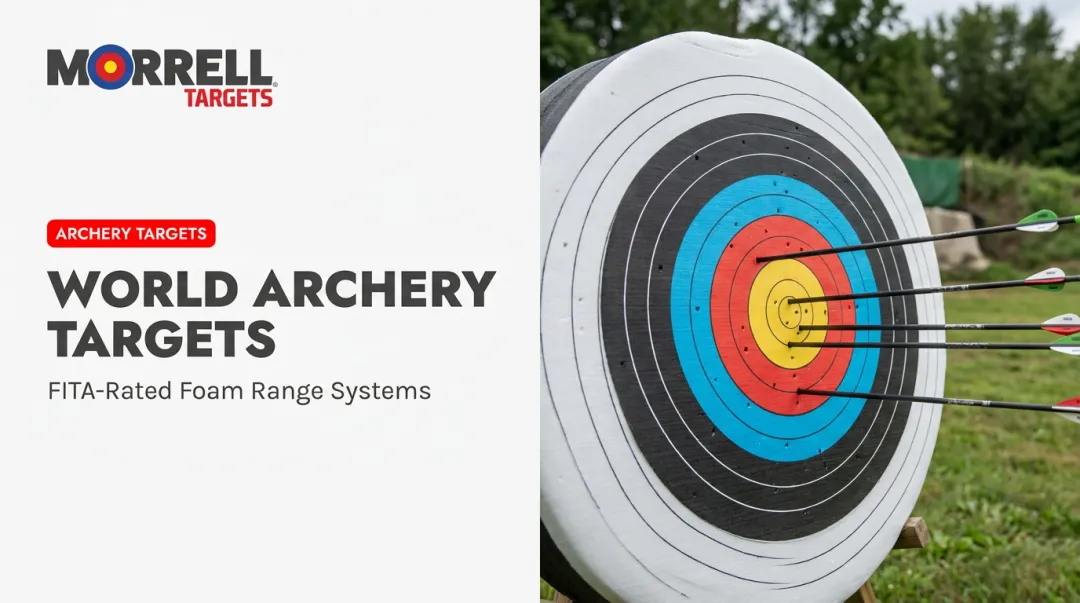
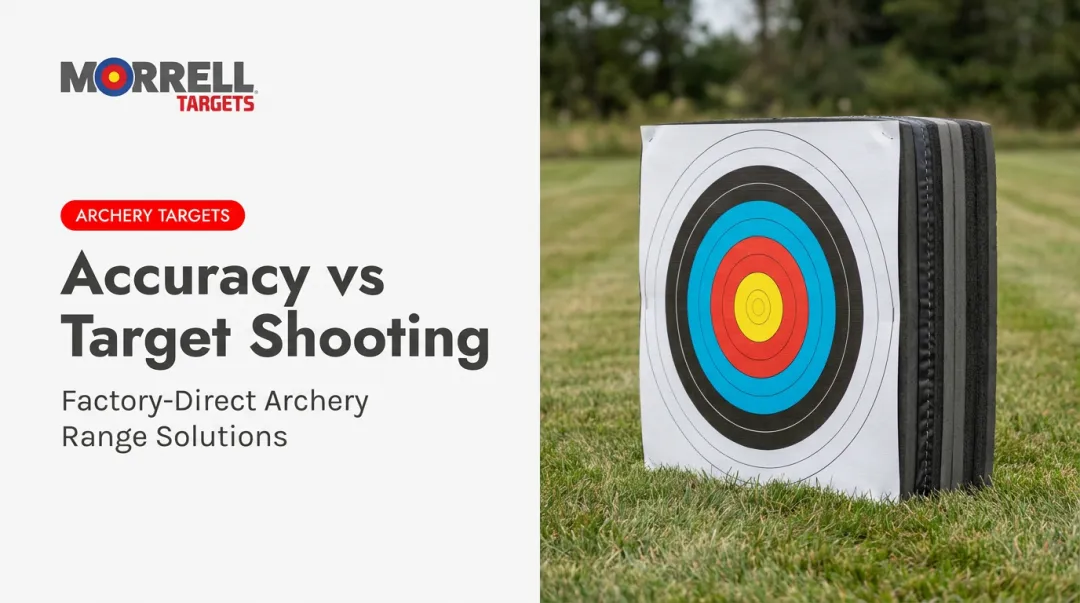
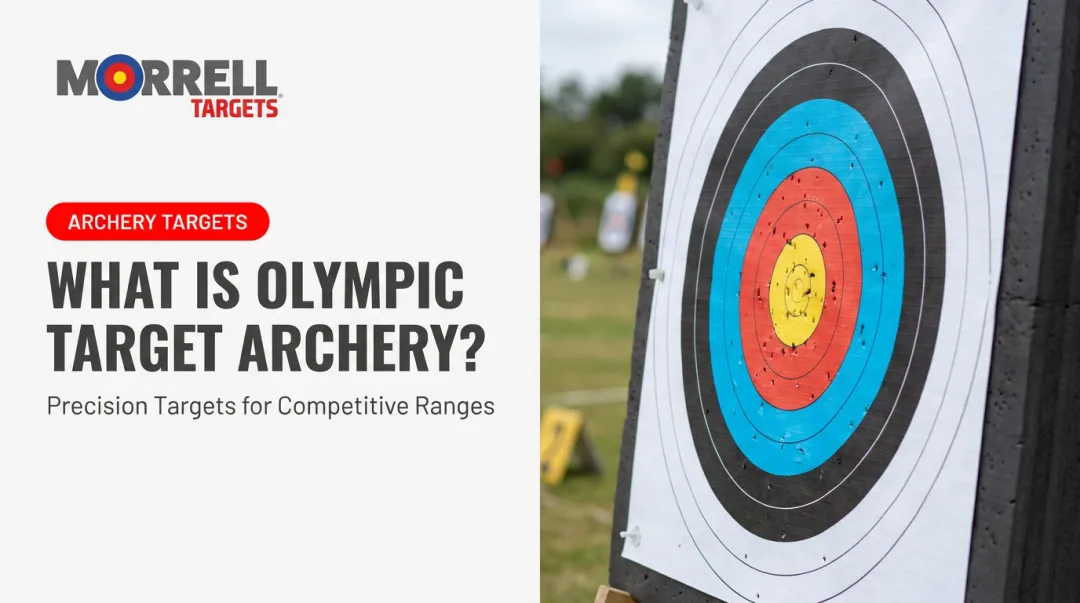
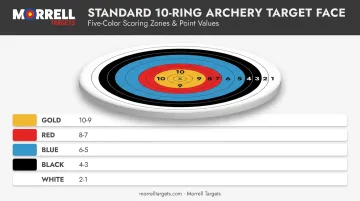
Most Metric and Olympic-style rounds use a five-color, ten-ring face, working from center outward:
- Gold/Yellow (center): 10, 9
- Red: 8, 7
- Blue: 6, 5
- Black: 4, 3
- White (outer): 2, 1
NASP follows this same five-color layout on an 80 cm face, with rings scored from 10 down to 1. The center X still counts as a 10, not an 11; it's simply used for tie-breaking purposes.
Imperial vs. Metric Scoring
Here's where a lot of archers get tripped up:
| System | Max score | Center zone | Zones |
|---|---|---|---|
| Imperial (Archery GB) | 9 | Gold | 9-7-5-3-1 |
| Metric/FITA | 10 | Gold, with X for ties | 10-9-8-7-6-5-4-3-2-1 |
Scoring Nuances Every Archer Should Know
Compound scoring is stricter: At 18 meters, World Archery's recurve 10-ring measures 4 cm, but compound archers must hit a much smaller 2 cm inner ring to score the same 10. Same target face, tougher target.
Line cutters favor the archer: If an arrow shaft touches or crosses the line between two zones, it scores the higher value. This rule applies across NASP, World Archery, and NFAA rulebooks as standard practice, not a loophole.
Not every round uses this system: The NFAA Worcester round throws out the 10-point model entirely. It uses a black-and-white face scored 5 through 1, shot over 12 ends of 5 arrows at 20 yards. Scoring isn't universal, and assuming it is causes real confusion at multi-format tournaments.
How Archery Scoring Works Step-by-Step
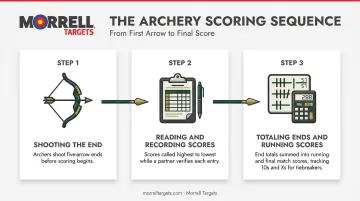
Once you understand point values, the actual scoring process is straightforward. Here's the flow from first arrow to final total.
Step 1: Shooting the End
Archers shoot a fixed group of arrows, called an "end," before anyone scores anything. NASP's 2026 bullseye rules specify five-arrow ends: one practice end followed by three scoring ends at 10 meters, then the same at 15 meters, for 30 scored arrows and a 300-point maximum. Other formats, like Worcester, use similar five-arrow ends but at different distances and point caps.
Step 2: Reading and Recording Scores
Scores get called out from highest to lowest per end, then recorded on a scorecard. NASP has one archer call and record a partner's arrows while the partner verifies each entry, then the roles reverse. Nobody touches the target until this is done.
Step 3: Totaling Ends and Running Scores
Individual end totals get summed into running totals, then final match scores. Scorecards also track 10s, Xs, or "golds" separately, since these numbers decide tiebreakers when two archers finish with the same total.
Common Scoring Mistakes to Avoid
- Assuming arrows must be fully inside a ring. Touching the line counts for the higher score under the line-cutter rule.
- Confusing "hits" with "golds." A hit is any scoring arrow, while a gold is specifically a center-zone hit; scorecards track them separately for tiebreakers.
- Skipping the partner verification step. Both archers should confirm each entry before signing, since unverified errors can slip through unnoticed.
Where Bullseye Scoring Is Used
Bullseye scoring shows up across three main settings:
- NASP school tournaments, using the 80 cm five-color face
- USA Archery and Olympic-style events, following World Archery's Metric system
- Local club rounds, which may follow Imperial, Metric, or NFAA rules depending on the host organization
Bullseye vs. 3D Tournaments
| Format | Target | Scoring range |
|---|---|---|
| Bullseye (standard face) | Fixed concentric rings | 0-10 |
| NASP 3D | Foam animal, vital-zone rings | 0, 7, 8, 9, 10 |
NASP programs use both formats because they build different skills: bullseye rounds reward precision on a known, fixed target, while 3D rounds train archers to judge distance and shot placement on irregular shapes.
Distance and setting change the face size too. Indoor rounds often use 40-80 cm faces, while outdoor rounds use 80-122 cm faces to account for longer shooting distances. Morrell manufactures polypropylene and paper target faces cut to these NASP, FITA, and NFAA specs, so ranges can match whichever format they run.
Factors That Affect Scoring Accuracy and Consistency
Scoring accuracy isn't just about your form. The equipment you're shooting at matters just as much.
Target Face Condition Changes What You Can Actually See
Worn rings, faded colors, and a collapsed foam core make it genuinely harder to call a score with confidence. If the line between the 9-ring and 10-ring has blurred from a season of repeated hits, even a good judge can't call it fairly.
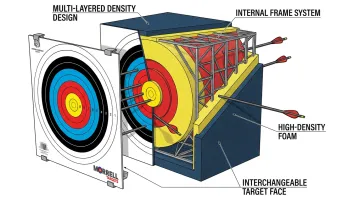
This is where target build quality earns its keep. Morrell® Targets builds its bag and foam targets around a patented Multi-Layered Density Design (MLDD), using anywhere from 76 to 100 layers of arrow-stopping fill depending on the model.
That layered construction, paired with the Internal Frame System (IFS), keeps the target's internal structure stable shot after shot. Scoring faces don't shift or distort over thousands of arrows.
Easy arrow removal plays a role here too. Founder Dale Morrell built his original bag target design in the 1980s specifically to solve this problem. Arrows that are hard to pull create lateral stress, tearing fabric and distorting the material around scoring rings. Clean extraction avoids that damage entirely.
For teams and ranges running high volume, Morrell also offers replacement covers and the Yellow Jacket MOD Pro system for when a face finally wears out. The MOD Pro swaps in seven interchangeable target faces, including NFAA, ASA/IBO, and long-distance 80 cm formats, using Velcro attachment with no tools required.
Distance and Bow Type Change Difficulty
Target condition aside, distance and bow type reshape the challenge too. A compound archer chasing that 2 cm inner 10-ring at 18 meters faces a tougher target than a recurve shooter aiming at the full 4 cm ring. Outdoor distances out to 70 meters test sight accuracy even further, regardless of bow type.
Arrow Diameter Affects Line-Cutter Calls
Bow and distance aside, arrow diameter changes the calls too: thicker shafts touch scoring lines more easily than thinner ones. That's why some competitive archers switch to smaller-diameter arrows specifically for indoor scoring rounds, where every fraction of a millimeter can shift a 9 into a 10.
Conclusion
Bullseye scoring is a structured system built to measure one thing objectively: accuracy. But the rings, point values, and rules shift depending on whether you're shooting NASP, Olympic-style Metric, Imperial, or 3D formats. Confirm which system you're under before assuming how points get awarded.
Beyond the rulebook, consistent scoring practice starts with a target that keeps its rings clear and its structure intact, shot after shot. Morrell Targets designs its foam and bag targets to meet that exact standard.
Frequently Asked Questions
How many points is a bullseye in archery?
It depends on the format. Olympic and Metric scoring award 10 points for the center (marked "X" for tiebreaks), while Imperial scoring caps the gold center at 9 points.
What are the points on an archery target?
Standard five-color faces score, from center outward: gold/yellow (9-10), red (7-8), blue (5-6), black (3-4), and white (1-2).
What is the highest possible score for a single arrow in archery?
Most Metric and Olympic formats cap at 10 points. Imperial rounds top out at 9, and Worcester-style rounds cap at 5.
Is the bullseye always worth the most points in archery?
Yes. Unlike darts, where a treble can outscore the bull, archery's center ring is always the highest-value zone, regardless of which scoring system is in play.
What's the difference between NASP and Olympic-style archery scoring?
NASP uses a five-color bullseye face similar to Olympic Metric scoring, but also runs 3D rounds with a restricted 0, 7-10 point range not used in standard Olympic target archery.
How is a "line cutter" scored in archery?
If an arrow shaft touches or crosses the line dividing two scoring zones, the archer automatically receives the higher of the two point values. This rule applies across NASP, World Archery, and NFAA formats.