
Introduction
Picture two archers with nearly identical form. Both draw smoothly, anchor consistently, and release with good follow-through. Yet after six weeks, one archer's groups have tightened into a tight cluster while the other's arrows still scatter across the target face.
The real difference is what happens after the arrow leaves the bow.
Many archers struggle with inconsistent arrow flight, targets that degrade unevenly, and arrow removal that gets harder shot after shot. These issues don't just damage equipment. They disrupt practice rhythm and slow down the entire skill-building process.
This guide breaks down what a consistency target actually is, why target reliability matters more than most archers realize, and which features separate a target built to last from one that sabotages your progress.
Whether you're coaching a NASP classroom or fine-tuning your own release, the target you shoot at matters as much as how you shoot.
Key Takeaways
- Consistent targets deliver the same stopping power and arrow removal across thousands of shots, not just hundreds
- Unreliable targets create compensatory habits that reinforce poor form instead of correcting it
- Core construction, internal frame systems, and rebuildable covers determine how long a target stays consistent
- Matching target density to your bow's draw weight prevents premature wear and inconsistent feedback
What Is a Consistency Target?
A consistency target is an archery target engineered to deliver the same resistance, the same arrow-stopping depth, and the same arrow removal experience on shot number 5,000 as it did on shot number one.
That's the whole concept. No soft spots. No gaps. No sudden pass-throughs after a target that felt fine the week before.
Why Standard Targets Fall Short
Most budget targets start strong but degrade unevenly. Repeated impacts concentrate stress in the same zones, creating soft spots that change how deep an arrow penetrates. Once that happens, your feedback loop breaks. You can't tell if a low group came from your form or from a target that's stopping arrows differently than it did last month.
"Consistency" here means two things:
- Target performance consistency: the product behaves the same way over its entire lifespan
- Shooter form consistency: a reliable target reinforces steady mechanics instead of forcing you to compensate
This matters across every skill level:
- NASP classrooms rely on it since hundreds of students shoot the same targets daily
- Tournament archers depend on it because one inconsistent stop can wreck an entire scoring round
- Backyard shooters need it so they're not stuck breaking bad habits every time a target wears out
Founder Dale Morrell ran into this exact problem in the mid-1980s. Working as a brick mason by day, he built his own bag target design in his garage because the targets available at the time didn't hold up.
His two goals were simple: easy arrow removal and real durability. That philosophy became the foundation for the company and still drives how Morrell approaches target construction today.

Why Consistency Matters in Archery Practice
Archery form develops through repetition your body eventually performs without conscious thought, a process sports scientists describe as motor learning. Occasional practice alone doesn't get you there.
Research backs this up with actual numbers. In a controlled study, 11 novice archers shot 100 arrows a day across three consecutive days, totaling 300 shots.
Scores improved measurably between day one and day three, with researchers reporting a statistically significant gain. That's short-term skill acquisition happening in real time, driven by nothing more than structured, repeated practice.
Here's the catch: that improvement depends on the practice conditions staying stable.
What Happens When the Target Isn't Reliable
When a target develops uneven density or a tough arrow pull, archers unconsciously adjust:
- Slightly altering anchor point to compensate for arrow drift
- Changing follow-through to account for unpredictable stopping resistance
- Yanking harder on arrow removal, which can affect stance and fletching
None of these adjustments improve form. They just teach the body to compensate for equipment problems, and those compensations tend to stick around long after you've switched to a better target.
Removing target inconsistency as a variable lets coaches and archers isolate what's actually happening in the shot. If a group opens up, it's a form issue, not an excuse.
This is exactly why NASP standardizes so tightly. NASP now reaches 1.2 million students across 9,535 schools annually, with nearly 99,000 unique competitive archers in the 2024-2025 season alone. When that many students shoot daily on shared equipment, target reliability determines whether skill assessment stays fair and comparable across schools.
Key Features That Make a Target Built for Consistency
Not all targets age the same way. The ones that hold up shot after shot share a handful of engineering traits.
Arrow-Stopping Core Technology
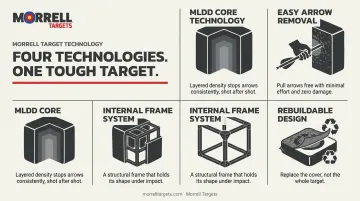
The core is doing the real work. Morrell's patented MLDD (Multi-Layered Density Design) stacks compressed layers at varying densities, so each layer progressively slows an arrow instead of relying on one uniform material. This spreads impact energy across the target's full depth rather than concentrating it in one spot. That's what prevents the soft-spot drift that ruins cheaper foam over time.
Easy, Consistent Arrow Removal
A target that grips arrows unevenly does two things: it damages fletching, and it interrupts your shooting rhythm every single time you have to yank hard. Easy removal was the original problem Dale Morrell set out to solve, and it remains a defining feature across the product line. That consistency keeps grip tension steady shot after shot, so you spend less time wrestling arrows free and more time shooting.
Internal Frame Systems and Weight
Morrell's IFS (Internal Frame System) maintains target shape and density under repeated impact, preventing the sagging and gap formation common in lower-cost targets. Weight and stability matter too. A target that shifts or wobbles on impact changes your feedback entirely, so heavier, well-framed designs hold their position shot after shot.
Rebuildable Design
Replacement covers extend a target's consistent life without buying a whole new unit. Products like the Outdoor Range and Supreme Range targets (76 layers of MLDD construction, rated up to 380 FPS) pair this rebuildable design with commercial-grade cores, letting archers restore original shooting feel once the outer cover wears out.
Building a Practice Routine Around Consistency
A reliable target only helps if your practice routine treats it as a fixed reference point.
- Lock in your distance and target zone. Shoot the same setup for a defined stretch, such as several weeks, before moving your distance or aim point. This turns the target into a stable benchmark for measuring real improvement.
- Rotate shot placement across the face. Concentrating every shot on one spot accelerates wear and creates soft spots that skew feedback later. Spread your impacts across the usable target area, or choose a target with multi-layered density construction, such as Morrell's MLDD technology, which resists concentrated wear.
- Log your sessions. Track group size, arrow removal ease, and any changes in how the target feels. This gives you two data sets at once: your personal progress and the target's remaining consistency.
Choosing the Right Target for Your Consistency Goals
Target types serve different consistency needs, and picking the wrong one is a common reason practice feels inconsistent even with good form.
| Target Type | Best For | Consistency Consideration |
|---|---|---|
| Bag targets | Repetitive field-point practice | Easy arrow pull, but generally not rated for broadheads |
| Block/foam targets | Multi-angle and broadhead work | Point compatibility varies — check manufacturer specs |
| 3D targets | Scored competition, angle variety | Consistency depends on replaceable insert quality |
Match target density to your setup. An underpowered target facing a high-poundage compound bow will degrade faster and lose consistency sooner than expected. Morrell's High Roller Foam targets, for example, are rated up to 450 FPS for higher-speed setups, while lighter NASP Youth targets are built for bows 45 lbs and under.
For archers who want long-term reliability without guessing on specs, Morrell's lineup spans this full range, from entry-level bag targets to commercial-grade compression cores. Every option shares the same durability and easy-removal design the company was founded on.
Maintaining Your Target for Long-Term Consistency
Even a well-built target needs basic upkeep to stay consistent.
- Rotate placement periodically so impacts don't concentrate in one zone
- Limit weather exposure for targets not rated for prolonged outdoor use
- Check for core compaction — a firmer or uneven feel in one area signals declining consistency
Even with regular upkeep, the outer face will eventually wear out. If the core structure is still sound, a Morrell replacement cover or rebuild kit restores performance without buying a new target.
Warning signs it's time to rebuild or retire a target:
- Visible sagging or shape loss
- Arrows passing through instead of stopping cleanly
- Core separation or exposed internal layers
- Noticeably harder arrow removal than when the target was new
Frequently Asked Questions
What is a consistency target?
It's a target engineered for repeatable, predictable performance, meaning consistent arrow stopping and easy removal across thousands of shots. That reliability supports steady, trustworthy archery practice over time.
How often should I practice with a consistency target to see improvement?
Several structured sessions per week, using the same distance and target setup, typically produce measurable form improvement within a few weeks. Consistency in your routine matters as much as consistency in your equipment.
What's the difference between a bag target and a block target for consistency training?
Bag targets suit repetitive field-point practice with easy arrow pull, while block or foam targets often accommodate broadheads and multi-angle shots. Always check the manufacturer's point-type rating before switching.
Can consistency targets handle field points and broadheads?
It depends entirely on the specific target's core design and manufacturer rating. Some foam targets, like Morrell's High Roller line, handle both, while standard bag targets are generally built for field points only.
How do I know when it's time to replace my archery target?
Watch for core compaction, pass-throughs, visible sagging, or arrow removal that suddenly feels tougher than usual. Any of these signal it's time to rebuild with a replacement cover or retire the target entirely.
Do consistency targets work for both compound and traditional bows?
Most quality consistency targets handle varying draw weights and bow types, but archers should still match target density to their setup's power. Higher-speed compound setups, especially those pushing 300+ FPS, need denser cores built to handle that added force.