Neither answer is complete, because they're solving different problems. Many archers chase equipment upgrades, new sights, stiffer arrow shafts, a fresh release, while ignoring the one variable sitting right in front of them: the target itself.
Target choice shapes practice habits more than most shooters realize. A target that's too forgiving hides flaws. One that's too small (or falls apart after fifty shots) breaks your rhythm before your form ever improves.
This guide breaks down the real difference between accuracy and precision, walks through how target type shapes what you actually learn each session, and shows how to pick equipment that builds good habits instead of masking bad ones.
Key Takeaways
- Accuracy is how close your shots land to your intended aim point.
- Precision is how tightly your shots group together, regardless of where they land.
- Your target's size, type, and material directly shape how fast you develop accurate habits.
- Smaller targets and varied distances expose form flaws that big, forgiving targets hide.
- Durable, rebuildable targets support the repetition volume that real accuracy gains require.
What Is Accuracy in Target Shooting?
Accuracy measures correctness, not consistency: it's the degree to which an arrow lands at or near your intended point of aim. According to Archery360's breakdown of accuracy versus precision, accuracy is simply "how close your arrows come to hitting your target," while precision is a separate measurement entirely.
That distinction matters because accuracy isn't judged off one lucky shot. It's judged by where your average shot lands across a full session. A target face with clear, high-contrast markings, such as Morrell's tournament-approved faces, makes it easier to see exactly where that average group forms.
What Actually Drives Accuracy
Several factors combine to determine where an arrow ends up:
- Shooter form - stance, alignment, and release consistency
- Sight or pin setup - whether your equipment matches your actual shot
- Bow tune - how well the bow and arrow work together in flight
- Arrow spine - the stiffness rating that determines flex during release
- Environmental conditions - wind drift, especially at longer distances
A mismatched arrow spine, for instance, can cause erratic flight no matter how good your form is. Draw weight, arrow length, and point weight all affect that flex. Get any one of them wrong and you'll fight accuracy issues that have nothing to do with your aim.
Here's the part beginners miss: you can have perfect form and still miss center if your sight is off. This is an accuracy problem, and diagnosing it looks different from fixing a form issue or a precision problem.
Accuracy vs. Precision: Understanding the Critical Difference
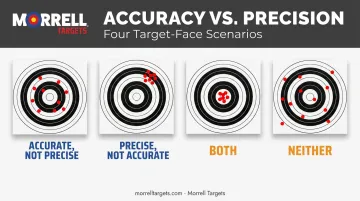
This is where most confusion starts: accuracy is closeness to the target's center. Precision is closeness of your shots to each other, no matter where that cluster sits on the face.
Think of it as four possible outcomes:
| Scenario | What It Looks Like | What It Means |
|---|---|---|
| Accurate, not precise | Shots scattered but centered around the bullseye | Good aim, inconsistent form |
| Precise, not accurate | Tight cluster off to one side | Good form, sight needs adjustment |
| Both | Tight cluster in the center | You're dialed in |
| Neither | Scattered shots, no pattern | Form and setup both need work |
A tight group sitting three inches low and left is precise, not accurate, while scattered arrows landing all around the bullseye are accurate on average, but not precise. Only a tight cluster centered on the mark is both.
Why This Distinction Changes Your Fix
Each scenario points to a different training response:
- Off-center but grouped tight? Adjust your sight, moving it toward the group: windage for left-right drift, elevation for up-down.
- Scattered with no pattern? That's a form issue, not a sight issue, so moving your sight won't fix inconsistent release or alignment.
- Tight and centered? You're dialed in, so keep tracking your groups to confirm the consistency holds under different conditions.
Archery360's guidance on sight adjustment recommends shooting a three-arrow group with good form before touching your sight at all. If the group holds together, you know exactly where to move it; if it doesn't, adjusting the sight is guesswork.
That's why serious archers evaluate performance over 3-5 arrow groups, never a single shot. One arrow tells you almost nothing, but a group tells you whether the problem is aim or execution.
How Target Type Shapes Your Accuracy Training
Your target does more than stop arrows: it shapes how you train. The wrong one can reinforce bad habits for months before you notice.
Bag Targets and Foam Targets
Bag targets use woven, filled shells; foam targets use dense or layered material designed to self-heal after impact. Both types handle high-volume, repeatable practice, which matters because accuracy training requires reps, not just occasional sessions.
Morrell's bag targets use a patented Multi-Layered Density Design (MLDD) to keep arrow removal consistent shot after shot, so the feedback you get on arrow 200 feels the same as arrow one. That consistency is what lets you trust what your groups are actually telling you.
The Problem With "Too Forgiving"
That consistency only helps if the target doesn't mask your mistakes. A large face with generous scoring rings feels good, but it hides:
- Minor stance drift
- Inconsistent release timing
- Subtle follow-through breakdowns
Smaller target faces and tighter scoring zones expose these flaws faster, simply because there's less room for error to hide.
Field, 3D, and Paper Targets
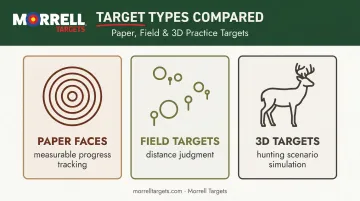
Target format changes what you're actually training for:
- Paper faces give you standardized scoring rings for measurable progress tracking.
- Field targets use varied sizes across marked and unmarked distances, testing distance judgment along with grouping.
- 3D targets simulate real hunting scenarios with life-size forms at unknown yardages, helping bowhunters translate range accuracy into field performance.
Durability Determines Training Volume
Choosing the right target type matters only if it survives repeated use. A target that degrades after a hundred shots forces you to stop, adjust your session, or avoid repetition altogether, right when repetition is what you need most. Morrell's High Roller Foam and internal-frame bag targets absorb high shot counts without losing their shape, so training sessions don't get cut short by wear.
Choosing the Right Target for Your Skill Level and Goals
Not every archer needs the same target, and using the wrong one can actually slow your progress.
Match Target Size to Skill Level
- Beginners: Start with larger scoring areas. Confidence and repeatable form come before precision.
- Intermediate: Shrink the target size once your groups tighten. Smaller zones start exposing form flaws that larger faces hide.
- Advanced: Push to the smallest scoring rings your skill allows. This forces the tight, repeatable form that separates good archers from great ones.
Match Target to Arrow Type
Pairing the wrong arrow with the wrong target damages both, and Morrell designates specific product lines accordingly. Field-point-only targets like the M48 line are built for standard field tips; broadheads chew through the fill material and shorten target life fast.
Broadhead-compatible foam targets, such as the Yellow Jacket YJ-350 Dual Threat rated up to 350 FPS, use poly-fused foam layers built to handle both broadheads and field points safely.
Build in Distance Progression
Start close enough to build fundamentals, then extend the distance in stages. Longer range magnifies small mistakes, which is exactly why it's useful: it tells you whether your accuracy holds up under harder conditions, or whether it only worked at short range.
For Schools, Clubs, and Ranges
Programs running high student volume need targets that survive thousands of shots. Morrell is an official supplier for the National Archery in the Schools Program, which now reaches over 1.2 million students across 9,535 schools annually, according to NASP's official program data.
That kind of shot volume demands targets built for sustained, repeated group use, not one-off recreational sessions.
Rebuild Instead of Replace
Full target replacement isn't always necessary. Morrell sells modular components like:
- Replacement covers for Yellow Jacket bag targets
- A replacement mid-section for the Center Punch 49 FITA Outdoor Range at $139.99, versus $299.99 for a full new unit, roughly a 53% savings
- Polypropylene and paper target faces sold separately for bag and range targets
Rebuilding extends usable life and keeps your training consistent instead of interrupting it with a full equipment swap.
Proven Tips to Improve Your Shooting Accuracy
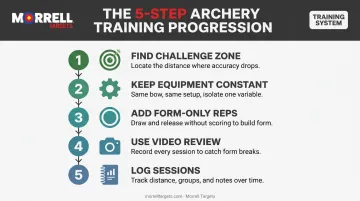
Real accuracy gains come from structured practice, not just more arrows downrange.
- Find your challenge zone. Start at a distance where you hit 75-80% of shots comfortably, then increase difficulty until success drops to 50-60%. That's where real improvement happens: too easy stalls progress; too hard just breeds frustration.
- Keep equipment constant. Same arrows, same sight, same setup, every session. Otherwise you can't tell if a miss is a form issue or an equipment variable.
- Add form-only repetitions. Shooting into a blank target (no face, no score) removes the pressure to aim and lets you focus purely on repeating your shot sequence.
- Use video review. Record your shots and review them immediately. Form breakdowns your target can't show you, like a subtle grip shift, show up clearly on camera.
- Log your sessions. Track distance, target size, and hit rate. A simple log turns "I feel like I'm improving" into an actual trend line.
Frequently Asked Questions
What is accuracy in shooting?
Accuracy is how close a shot lands to your intended point of aim. It's distinct from precision, which measures how tightly your shots group together regardless of where that group sits.
What is the difference between an accuracy target and a precision target?
An accuracy-focused pattern shows shots landing near center, even if scattered. A precision-focused pattern shows a tight cluster, which may or may not be centered on the bullseye.
What are the different types of targets?
Bag and foam targets work well for high-volume practice, while field and 3D targets simulate outdoor hunting conditions. Paper targets offer standardized scoring you can track over time.
How can I improve my shooting accuracy fastest?
Practice at progressively harder distances, keep your equipment consistent between sessions, and shrink your target size to expose form errors that larger faces hide.
What target is best for beginners learning accuracy?
Larger, durable bag or foam targets with clear scoring zones work best. They build confidence and repeatable form before you progress to smaller, less forgiving faces.
How often should I replace or rebuild my archery target?
It depends on shot volume and target design. Rebuildable targets with replacement covers, like several Morrell models, extend usable life compared to one-piece targets that require full replacement.