

Morrell® Targets has built bag and range targets around exactly this problem since 1986: easy arrow removal so vanes survive the session, and durability built for the volume that tuning actually demands. That combination makes a Morrell target the right platform to tune against, whatever rest you're running.
This guide covers the main rest types available for compound bows, the mounting hardware shift happening across the industry, and the tuning methods that work on any of them.
Key Takeaways
- Drop-away rests (limb- or cable-driven) minimize arrow contact for maximum accuracy
- Full-capture rests sacrifice slight speed for added durability and dead-quiet operation
- IMS-compatible mounts are replacing the older Berger-hole standard on newer bows
- Proper tuning requires shooting volume - a durable practice target with easy arrow removal matters as much as the rest itself
Understanding Arrow Rests for Compound Bows
An arrow rest is the device that cradles and guides the arrow through the draw cycle, keeping it level with the nocking point until you release. In practice, the rest is one of the few components that touch the arrow during every phase of the shot, which means any inconsistency here shows up downrange.
The biggest shift in this market has nothing to do with launcher shape. It's mounting hardware.
Integrate Mounting System (IMS), introduced alongside the 2019 Mathews Vertix, replaced the older bolt-on "Berger hole" standard. QAD, which co-developed IMS, describes the dovetail clamp as securing the rest on three axes instead of two, auto-leveling it and reducing bulk near the riser.
Mathews, Hoyt, PSE, Bowtech, Prime, Bear, and several other major bow brands now machine IMS rails into their risers.
Alongside IMS, a few other trends define the current lineup:
- Micro-adjustability - tool-less or near-tool-less windage and elevation dials with laser-etched reference marks
- Vibration dampening - rubber overmolds, elastomeric bumpers, and rebound dampeners that quiet the shot and stop launcher bounce-back
- Full-containment designs - drop-away arms with capture brackets that keep the arrow secured during awkward stalking angles or treestand shots
Types of Arrow Rests for Compound Bows
Understanding rest mechanics is the first real step toward choosing the right one, since each type trades off accuracy, noise, durability, and cost differently.
Drop-Away Rests (Limb-Driven vs. Cable-Driven)
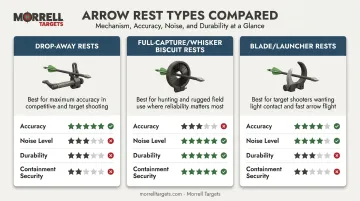
Drop-away rests lower the launcher arm out of the arrow's path the instant you release, eliminating fletching contact almost entirely. Two mechanisms make this happen:
- Limb-driven: A cord ties to the limb, and limb movement during the shot pulls the launcher down
- Cable-driven: A cord ties to the bus cable instead, timing the drop to cable travel
Limb-driven rests are simpler to diagnose and repair in the field if something goes wrong mid-hunt. Cable-driven rests are prized for their precision and dominate competitive target archery because the timing is more consistent shot to shot.
Full-Capture / Whisker Biscuit Rests
Unlike the timing-dependent drop-away designs, full-capture rests remove the mechanism entirely: a ring of bristles fully encloses the arrow, so there's nothing to time and nothing to fail. This makes full-capture rests popular with beginners and hunters who value reliability over squeezing out the last few feet-per-second.
The trade-off is real: bristle contact can marginally reduce arrow speed and accuracy at longer distances, and worn bristles compound the effect over time.
Blade / Launcher Rests
At the opposite end of the containment spectrum, a simple v-groove blade supports the arrow with minimal contact, common on dedicated target compound setups. Blade rests offer excellent precision at known distances but provide far less containment security, which is why most hunters steer clear of them for field use.
How to Choose the Right Arrow Rest
The right rest depends on shooting style, typical shot distance, and how much you value simplicity versus fine-tune control:
- Accuracy-focused target shooters generally benefit most from a cable-driven drop-away rest with micro-adjustability and IMS compatibility if their bow supports it
- Hunters and beginners often do better with a full-capture rest - fewer moving parts, nothing to time, and reliable performance in the field
- Dedicated target compound shooters at known distances sometimes prefer a blade rest for its minimal contact and clean release
Picking a rest based on price or brand loyalty alone ignores actual shooting style. A 3D competitor and a treestand bowhunter have very different priorities, even if they're shooting the same bow.
IMS vs. Berger hole: If your bow has an IMS rail machined into the riser, look for a rest designed for that dovetail mount. If your bow uses the older Berger hole standard, traditional bolt-on rests still work well - just verify the rest's mounting system before purchasing.
Tuning and Testing Your Arrow Rest
Buying the right rest is only half the job. Even a well-engineered launcher needs proper tuning through paper tuning or bare-shaft testing before you trust it in the field or on the line.
Paper tuning involves shooting through a sheet of paper at close range and reading the tear pattern. A perfect bullet hole means the arrow is flying straight; horizontal or vertical tears indicate the rest needs windage or elevation adjustment. Bare-shaft testing compares the flight of a fletched and unfletched arrow - a bare shaft that groups consistently with fletched arrows confirms the rest is properly timed and aligned.
Both methods take volume. Dialing in windage and elevation adjustments means shooting the same setup dozens of times in a row, which puts real demand on your practice target:
- Handles thousands of impacts without breaking down
- Releases arrows easily so fletching and vanes don't get damaged pulling them free
- Holds up outdoors across a full tuning season, not just a weekend
This is exactly the problem Morrell® Targets was built to solve. Since 1986, Dale Morrell's founding principle has been easy arrow removal and long-term durability - the two properties that matter most when you're pulling arrows fifty times in a single tuning session. Archers can run adjustment after adjustment without shredding fletching or second-guessing the target itself.
Pairing a freshly installed rest with a Morrell target means your tuning data stays clean: the variable you're adjusting is the rest, not the damage accumulating on your fletching or the condition of your target.
Frequently Asked Questions
How do you choose the right arrow rest?
Base it on shooting style, typical shot distance, and desired adjustability. Drop-away rests suit accuracy-focused shooters, while full-capture rests suit beginners and hunters who value simplicity.
What is the most durable type of arrow rest?
Full-capture rests rank among the most durable since they have no moving parts to fail. Premium drop-away rests counter this with aircraft-grade aluminum and stainless components built for long-term field use.
What type of arrow is best for target shooting?
Target archers typically want consistent spine and weight matched to their bow's specifications, paired with a micro-adjustable rest for maximum precision. Consistency matters more than any single material choice.
What is a drop-away arrow rest?
It's a rest whose launcher arm falls away from the arrow at the shot, triggered by a limb-driven cord or a cable-driven mechanism. This eliminates fletching contact and improves downrange accuracy.
Are whisker biscuit (full-capture) rests good for accuracy?
They're reliable and quiet, but bristle contact can slightly reduce arrow speed and accuracy at longer ranges. Most reviewers consider them excellent for typical hunting distances under 50 yards.
Why does the practice target matter for rest tuning?
Tuning requires shooting volume - often dozens of arrows per session over multiple sessions. A target that resists damage shot after shot and releases arrows without dragging on vanes keeps your fletching intact and your data accurate. Morrell® Targets are engineered for this: high-volume use with easy arrow removal built in from the design stage.