Many archers and range owners underestimate how much a 50m target setup affects daily practice. An undersized face throws off scoring accuracy. A weak backstop chews through arrows and shortens equipment life. And a wobbly stand adds inconsistency you can't shoot your way around.
This guide breaks down target face sizing, backstop construction, and the buying factors that matter most, so archers, coaches, and range owners can build a 50m station that actually holds up.
Key Takeaways
- 80cm faces fit compound divisions; 122cm faces fit barebow, both at 50 meters
- Foam density, arrow-speed rating, and backstop size affect arrow retention and target lifespan
- Outdoor durability matters most at 50 meters, where most shooting happens outside
- Rebuildable targets with replacement covers cost less over time than repeat purchases
What is a 50 Meter Archery Target?
A 50m archery target combines a scoring face and a backstop rated to safely absorb arrows shot from 50 meters, the setup used across USA Archery and World Archery outdoor competition.
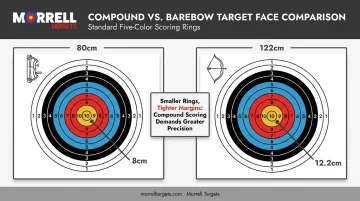
The face size depends entirely on discipline. World Archery's rulebook sets the 80cm face for compound at 50m and the 122cm face for barebow at the same distance, each governed by official event rulebooks that vary slightly by age class.
Core Components of a 50m Target Setup
A complete 50m target relies on three parts working together: the face for scoring, the butt for stopping arrows, and the stand for holding everything steady. Skip on any one piece, and the whole system underperforms.
Target Face
The face uses a five-color, 10-ring scoring system: gold, red, blue, black, and white. Here's where it gets specific by discipline:
| Discipline | Face Size | 10-Ring Size |
|---|---|---|
| Compound | 80cm | 8cm |
| Barebow | 122cm | 12.2cm |
That size difference reflects the precision each discipline demands. Compound bows, with sights and stabilizers, are held to a tighter standard.
Backstop/Target Butt
The butt, whether foam, layered foam, or a straw boss, needs enough density and thickness to fully stop arrows without letting them pass through. At 50m, arrows carry real speed and energy on impact, so a thin or worn-out butt simply won't hold up.
Stand or Frame
The stand keeps the butt at the right height and angle. Stability matters more here than at shorter distances. A stand that shifts or tips during a session throws off consistency, and at 50m, that's a safety issue as much as an accuracy one.
Benefits of Using a Purpose-Built 50m Target
A dedicated 50m target setup pays off in ways an improvised backstop never will:
- Standardized scoring that matches real competition conditions, so practice scores actually mean something
- Consistent arrow stopping at long range, reducing pass-throughs and lost shafts
- Safer group practice, since a properly rated butt and stable stand reduce ricochet and tip-over risk
- Longer product life, especially with reinforced designs like Morrell's IFS-equipped targets, compared to homemade or undersized backstops that break down under repeated long-range impact
Clubs running weekly practice sessions feel this difference fastest. A target that can't keep up with volume slows practice down instead of speeding it up.
What to Consider When Choosing the Best 50 Meter Archery Target
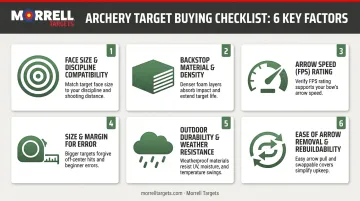
Requirements shift depending on the setting. A club prepping archers for tournaments needs different specs than a school running NASP programs or an individual practicing in the backyard. The factors below, including face size, foam density, and fps rating, connect directly to outcomes that matter: accuracy, arrow retention, and target lifespan.
Target Face Size & Discipline Compatibility
Using the wrong face size doesn't just look off. It disqualifies your practice scores from matching real competition standards. USA Archery's age classes and divisions guide lists exact face sizes by age class and division, and the differences matter:
- Senior compound shoots 50m at an 80cm face
- Senior barebow shoots 50m at a 122cm face
- U18 compound also shoots 50m, but recurve at that age shoots 60m
KPI affected: scoring accuracy and tournament rule compliance.
Backstop Material & Density
Foam density determines how well a butt resists repeated impact without core failure. Morrell's High Roller Foam is built with self-healing properties, meaning the foam closes back around arrow entry points after each shot, which extends usable life well beyond standard foam cores.
One caveat worth knowing: broadheads slice through foam rather than letting it close naturally. Field points preserve the self-healing benefit; broadheads accelerate wear. If you're using a 50m target for field-point practice, that distinction directly affects how long the foam lasts.
Why it matters: target lifespan and cost-per-shot over time.
Arrow Speed (FPS) Rating
Compound bows shooting at higher velocities need a backstop rated for that speed range to avoid pass-throughs. Morrell's Outdoor Range XXL stops arrows up to 380 fps, while the Center Punch 49" FITA system, built for tournament-style faces from 40cm to 122cm, handles speeds up to 450 fps.
KPI affected: arrow retention rate and equipment protection.
Size and Margin for Error
At 50 meters, even a slight aiming error translates into a wide arrow spread downrange. A larger butt surface catches more of those off-center shots.
The Center Punch 49" FITA, at 49" wide and 49" tall, gives archers a bigger margin than a standard-sized bag target. That extra surface matters when a group session includes shooters at different skill levels.
Practical impact: arrow loss rate and session efficiency.
Outdoor Durability & Weather Resistance
Since 50m shooting happens almost exclusively outdoors, weather resistance isn't optional. Archery GB's facilities guidance notes that outdoor targets need secure anchoring and backstop netting, though netting alone can't guarantee every arrow stops.
Look for:
- Weather-resistant shells or wraps, such as polypropylene covers
- Secure anchoring points for wind resistance
- Materials that shed water instead of absorbing it
KPI affected: replacement frequency and total cost of ownership.
Ease of Arrow Removal & Rebuildability
Foam that grips too tightly slows down practice sessions fast, especially when you're pulling dozens of arrows an hour.
Morrell's M48 Commercial Range target is built around "easiest arrow removal" as a core design goal. Several product lines, including the NASP Youth series, also offer replacement covers, so owners can swap a worn shell instead of buying an entirely new unit.
Bottom line: practice throughput (arrows shot per hour) and long-term replacement costs.
How Morrell® Targets Can Help
Morrell has spent over 40 years building targets designed for exactly this kind of heavy outdoor use. That commitment traces back to founder Dale Morrell's original garage-built bag target, created because he wanted easier arrow removal and better durability than what was available at the time.
That same focus shows up across Morrell's current lineup:
- Made-in-the-USA construction, manufactured at the company's Alma, Arkansas facility
- Internal Frame System (IFS) technology built into models like the NASP Youth target for added stability
- **High Roller Foam shooting core**, engineered for self-healing performance and easier arrow pulls
- Rebuildable design, with replacement covers available separately so a worn shell doesn't mean a whole new target
- Official NASP supplier status, trusted by school programs and tournament organizations nationwide
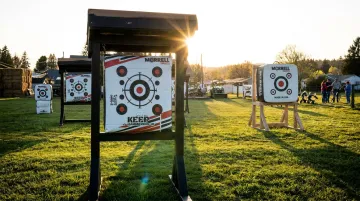
Whether you're outfitting a club's 50m practice range or setting up a school archery program, Morrell's outdoor target lineup follows the same idea Dale started with. It's built to hold up to volume and stay easy to keep shooting.
Conclusion
The right 50m target matches your discipline, whether that's compound's 80cm face or barebow's 122cm face, your shooting volume, and the outdoor conditions your range actually deals with.
Beyond that fit, foam density and covers wear down with heavy use, so check target performance periodically rather than waiting for a pass-through to signal it's time.
Morrell® Targets builds its foam and bag targets with rebuildable cores and replacement covers, letting you refresh worn parts instead of replacing the whole unit. That supports consistent long-range practice for years, not scrambling to replace equipment every season.
Frequently Asked Questions
What size target should I use for 50m archery?
Compound archers use an 80cm target face, while barebow archers use a 122cm face at 50 meters, per USA Archery and World Archery rules.
How far away should an archery target be?
Distance depends on discipline and skill level. Fifty meters is standard for compound and barebow outdoor competition, while recurve shoots 70 meters and youth classes vary by age.
What is the longest-lasting archery target?
Rebuildable foam targets with replaceable covers and dense, self-healing cores last longest, since worn covers or cores can be swapped instead of replacing the whole unit.
Why do compound archers shoot at 50m?
World Archery rules set 50 meters as the standard outdoor distance for compound divisions, using an 80cm face with a smaller 8cm 10-ring to match the discipline's precision.
Should I choose a weather-resistant target for 50-meter outdoor shooting?
Yes. Most 50-meter shooting happens outdoors, so choose a target built to handle rain, UV exposure, and temperature swings. Weather-resistant covers and dense cores stop water absorption that speeds up wear and reduces stopping power.
Can I use a regular bag target for shooting at 50 meters?
A bag target can stop arrows at 50m if it's large and dense enough, but it won't have official scoring rings, making it better suited to practice than sanctioned competition.