
Here's the problem: a lot of archers and coaches set up practice sessions using whatever backyard target is on sale, then wonder why their scoring feels off at a real tournament. Generic targets often don't match WA distances, face sizes, or color zones, and that mismatch throws off scoring practice before an arrow ever leaves the string.
This guide breaks down the real specs: distances, target face sizes, colors, scoring, and how to pick a target sturdy enough to survive thousands of shots without falling apart.
Key Takeaways
- Outdoor distances: 70m for recurve, 50m for compound and barebow
- Indoor distance: 18m, standardized across all divisions
- Official faces use a 5-color, 10-ring system ranging from 40cm to 122cm
- The X-ring is a tiebreaker only; it still scores a full 10 points
- Durability matters: compliance means nothing if the target breaks down after a few hundred arrows
What Is World Archery?
World Archery is the international governing body recognized by the International Olympic Committee for all archery disciplines. It was founded in 1931, and today its rulebook governs everything from the Olympics to the Archery World Cup. USA Archery serves as the U.S. national affiliate, applying WA's rules domestically.
WA sets the standardized distances, target specifications, and scoring rules used at:
- The Olympic and Paralympic Games
- World Archery Championships
- Archery World Cup events
Target archery, stationary circular targets at set distances, is the most widely practiced and recognized discipline globally. It's distinct from a few related formats:
| Discipline | What makes it different |
|---|---|
| Target archery | Fixed distances, standardized round faces |
| Indoor archery | Short-distance version of target archery, run indoors |
| Field archery | Varying distances, angles, and terrain on a course |
| Para archery | Competition for athletes with physical or visual impairments, under its own classification system |
Indoor archery isn't a separate ruleset so much as a compact version of the same sport. Para archery, meanwhile, is about athlete classification, not a different target setup.
How Far Do Archers Shoot? World Archery Target Distances Explained
This is the question most new archers and coaches ask first, and the answer depends entirely on bowstyle and venue.
Outdoor qualification distances:
- Recurve: 70 meters
- Compound: 50 meters
- Barebow: 50 meters
Indoor qualification distance: All divisions shoot 18 meters.
Every archer shoots the same indoor distance regardless of bow type, which is part of why indoor season is so popular for club-level competition. One target setup works for everyone.
The Legacy 1440 Round
Before single-distance formats became standard, World Archery (WA) used the 1440 Round, adopted back in 1955. Men shot 36 arrows at each of four distances (90m, 70m, 50m, and 30m) for a possible 1440 points. Women shot a similar progressive sequence at 70m, 60m, 50m, and 30m.
WA has since shifted toward single-distance qualification followed by head-to-head matches. The stated goal was to simplify the format and make competitions easier for spectators to follow, not to change the underlying 10-zone scoring concept.
Imperial and Yard-Based Rounds
Not every archery tradition uses metric distances. Some UK domestic rounds, including the historic York Round, measure distance in yards rather than meters. These formats exist alongside WA's metric system but sit outside official WA competition rules. That distinction matters if you're comparing club scoresheets from different countries.
Distance at a Glance
| Format | Recurve | Compound | Barebow | Notes |
|---|---|---|---|---|
| Outdoor (current) | 70m | 50m | 50m | Standard qualification |
| Indoor | 18m | 18m | 18m | Same for all divisions |
| 1440 Round (legacy) | Up to 90m | — | — | Progressive, four distances |
| Imperial/yard rounds | Varies | Varies | Varies | UK domestic tradition |
Distance also determines which target face size you need, which is where scoring gets interesting.
World Archery Target Faces: Sizes, Colors & Scoring Explained
WA competition uses four standard face diameters, each paired with a specific distance and division under Book 2 of the WA rulebook.
| Face size | Used for |
|---|---|
| 122cm | Recurve at 70m; barebow at 50m (full 10-ring face) |
| 80cm | Compound at 50m (reduced six-ring face) |
| 60cm | Additional outdoor rounds and para-archery divisions specified in Book 2 |
| 40cm | 18m indoor round, in full and reduced center variants |
The 5-Color, 10-Ring System
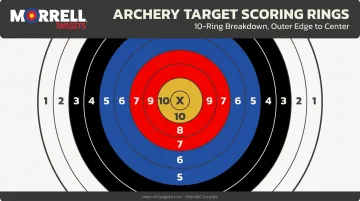
Every full face is divided into five colors, each split into two scoring zones:
- White: 1-2 points
- Black: 3-4 points
- Blue: 5-6 points
- Red: 7-8 points
- Gold: 9-10 points
That's ten concentric rings from edge to center, with gold holding the two highest values.
The X-Ring: Tiebreaker, Not a Bonus
The inner-10, commonly called the X-ring, still scores exactly 10 points. Its only job is breaking ties — when two archers finish with the same score, the one with more X's (or arrows closest to dead-center) wins. Beyond qualification rounds, actual ties for elimination spots get settled with a shoot-off instead.
Line breaker rule: if an arrow shaft touches two colors or crosses a dividing line, it scores the higher value. No debate needed.
Reduced Faces for Compound and Indoor
Not every face shows all ten rings. The 80cm compound face removes zones 1-4 entirely, showing only blue, red, and gold from 5 through 10 — no white or black. This tightens scoring at 50m to reflect the accuracy compound bows are capable of. Morrell's 80cm FITA paper target faces are cut to this exact spec, giving compound archers a direct match for tournament-style practice on the range.
Indoor competition also uses reduced-center faces, sometimes called vertical or triangular triple faces, which spread scoring across separate small centers instead of one central spot. This spreads out arrow impact and reduces the odds of one arrow splitting another dead-center, something archers commonly call "Robin Hooding."
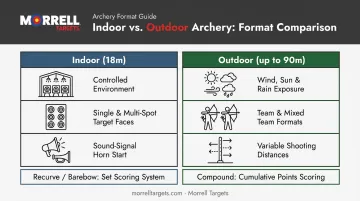
Indoor vs. Outdoor World Archery Targets: Key Differences
Indoor and outdoor competition share the same core scoring logic, but the environment and match structure differ quite a bit.
Indoor (18m):
- Controlled environment, no wind, no sun glare
- Single or vertical multi-spot target faces
- Sound signals manage the shooting sequence — two signals to the line, one to start, two to stop
Outdoor (up to 90m in traditional rounds):
- Wind, sun, and rain all factor into shot execution
- Full team and mixed team formats added alongside individual matches
- Broader range of distances depending on the round format
Match Scoring Differs by Bowstyle, Not Venue
The scoring method depends on bowstyle, not on venue: it works the same whether the round is indoor or outdoor.
| Division | Match system | Scoring |
|---|---|---|
| Recurve/barebow individual | Sets, first to 6 set points | Best of up to 5 sets, 3 arrows each |
| Recurve/barebow team | Sets, first to 5 set points | Up to 4 sets, 6 arrows each |
| Compound individual | Cumulative | 5 ends x 3 arrows, max 150 |
| Compound team | Cumulative | 4 ends x 6 arrows, max 240 |
Recurve and barebow archers win matches by set points. Compound archers add up every arrow shot. Both formats apply the same way whether the round is indoor or outdoor.
What Makes an Archery Target Long-Lasting? Choosing Quality for Practice
Here's a frustration a lot of coaches and range owners run into: a target checks every box for official sizing, but it's falling apart after a few weeks of regular practice. Foam breaks down, arrow holes won't self-seal, and pulling arrows becomes a two-hand wrestling match.
Specs on paper don't guarantee durability in practice. What actually separates a target that survives a season from one that doesn't comes down to a few build factors:
- High-density foam cores that resist compression fatigue after repeated hits
- Internal frame systems that keep the target's shape intact under heavy use
- Compression technology engineered to absorb thousands of impacts without breaking down at the core
Rebuildable Beats Disposable
A target with a replaceable outer cover offers better long-term value than one you have to throw out entirely once the face wears through.
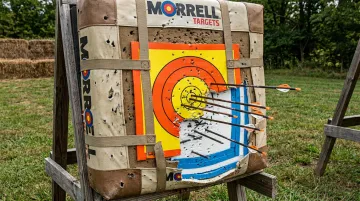
Morrell's Center Punch 49 FITA Outdoor Range, for example, uses a modular design with a replaceable mid-section sold separately, so the heaviest-wear area gets swapped out instead of the whole target.
Morrell® Targets has built targets in Alma, Arkansas, for over 40 years and serves as an official supplier to the National Archery in the Schools Program (NASP). That kind of institutional use, where thousands of students shoot the same targets year after year, tends to expose weak designs fast.
Easy arrow removal and a core that doesn't need replacing every season are the two things that matter most once a target sees real-world volume.
Quick buying tip: match your target's face size and color scheme to official WA specs if you want realistic scoring practice. But prioritize core material quality, arrow removal ease, and rebuild options first — those are what determine whether your target survives one season or five.
Frequently Asked Questions
How far do they shoot in World Archery?
Recurve archers shoot 70m outdoors, while compound and barebow shoot 50m. Indoors, every division shoots the same 18m distance.
What is the longest lasting archery target?
Targets with dense foam cores, internal frame systems, and rebuildable designs (such as Morrell's) last far longer than standard foam or straw targets. The core doesn't need replacing when the cover wears out.
What size is a World Archery target?
WA uses four standard face sizes: 40cm (18m indoor), 60cm, 80cm (50m compound), and 122cm (70m recurve, 50m barebow).
What do the colors on a World Archery target mean?
The 5-color, 10-ring system runs white (1-2), black (3-4), blue (5-6), red (7-8), and gold (9-10), with gold holding the two highest scoring zones.
What's the difference between indoor and outdoor World Archery targets?
Indoor is shot at a fixed 18m with a controlled environment, while outdoor extends up to 70m and adds wind, sun, and rain as variables. Face size and match format also shift accordingly.
Can I buy a World Archery-compliant target for practice at home?
Yes. Choosing a correctly-sized, durable target (like those from Morrell) lets you practice with accurate scoring while standing up to thousands of shots over time.